'Major deterrent' needed for small boats, says Ed Davey

Sir Ed calls for tougher action on Channel crossings
- Published
The leader of the Liberal Democrats has said a "major deterrent" is essential to end small boat crossings across the Channel.
In an interview with BBC South East, Sir Ed Davey said the size of the coastline meant "unless we have a major deterrent like a returns agreement with every single EU country, we won't sort it".
He said the current situation was "not good for the country" or the "people who put their lives in danger" and reiterated his call for the UK to join the new EU migration pact.
The Home Secretary Shabana Mahmood said it was a "mistake" to see the EU pact as "some sort of silver bullet."
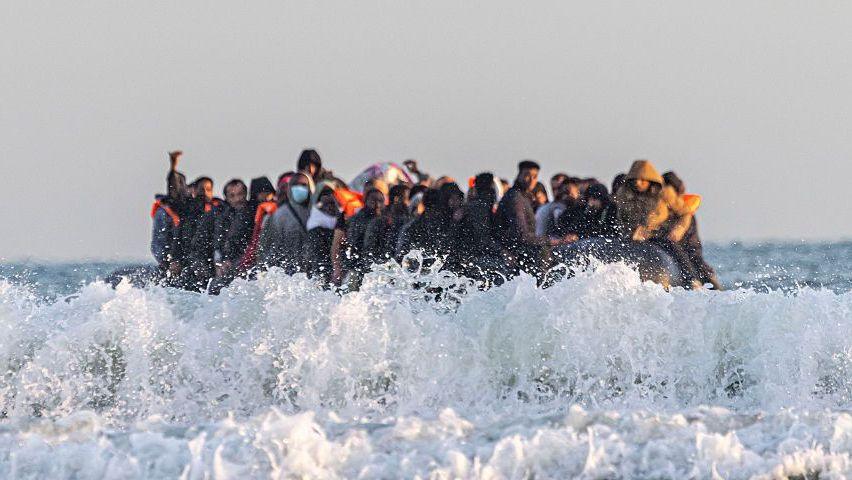
Between 1 January and 14 September 2026, a total of 17,425 people crossed the English Channel by small boat from France. This was down by 44% on the same period the previous year.
Sir Ed argued that joining the new EU migration pact was the "only practical solution" to end small boat crossings completely.
How many people cross the English Channel in small boats?
Between 1 January and 27 September 2026, a total of 19,135 people crossed the English Channel by small boat from France. This was down by 42% on the same period the previous year.
These crossings have become the most common way for people to be detected entering the UK illegally since 2020.
Nearly all those who arrive by small boat claim asylum. Under international law, this means they are allowed to stay in the country while their asylum application is considered.
Small boat arrivals made up 40% of asylum applications between July 2025 to June 2026.
Boats that arrived in the UK from 28 September 2025 to 27 September 2026 carried an average of 67 people. This has more than doubled since 2021.
Experts say overcrowding in boats makes crossings riskier. At least 84 people died while attempting to cross the Channel in 2024, according to the United Nations (UN).
When looking at the scale of small boats crossings, the number of these arrivals is about 5% of the size of total immigration into the UK from January 2025 to December 2025.
The government has pledged to “smash the gangs” behind these crossings in order to reduce the numbers.
Who is arriving in the UK on small boats?
People from Eritrea accounted for 18% of all arrivals from July 2025 to June 2026.
In the latest figures covering January 2025 to December 2025, at least 2,335 people who arrived by small boat were found to be potential victims of human trafficking or other forms of modern slavery, according to the Home Office.
How else do people stay in the UK without permission?
Another 4,712 people were detected entering the UK without permission via other methods including hiding in vehicles, travelling on ferries or through airports from July 2025 to June 2026. This was down by 17% on the same period the previous year.
There are also individuals who arrive legally, for example via a work or study visa, and then overstay their limit.
The total number of people who live in the UK illegally after arriving legally is not known.
The Liberal Democrats have blamed the emergence of the crossings on the lack of a returns agreement between the UK and EU after Brexit.
"We didn't have [small boat crossings] before Brexit," he said, "because then we had returns agreements and if we were to join the EU migration pact we would be able to return every single person coming over on small boats".
Asked why previous returns agreements had not stopped migrants crossing the Channel by stowing away in lorries while the UK was in the EU, Sir Ed said they had provided a deterrent effect, as he claimed the number of people crossing had been "much, much smaller".
However, he said there had been a "problem in the past, even before we left the EU" in "getting that law enforced" which he said was the key "so the returns agreements actually operate".
He claimed the new pact "had a number of dimensions to it" which would make it more effective.
Sir Ed first called for the UK to join the EU's new Migration and Asylum Pact back in August.
The pact, which came into force in June 2026, introduces mandatory screening and an updated database to track those arriving in the bloc.
Under the rules, EU nations must take in migrants from those member states that see the highest number of arrivals - such as Italy and Greece - or instead provide extra funding or resources.
Mahmood earlier told MPs on the Home Affairs Select Committee that it would be "a real mistake to think that pact is the future and if we were in that, this problem would go away because, I promise you, it would not".
Human rights and sustainability concerns
The Human Rights group Human Rights Watch has previously claimed that the EU pact undermined the rights of asylum seekers., external
Asked about their concerns, Sir Ed said the pact was "compliant with the European Convention [on Human Rights] and I think that gives us all the confidence we need".
"The key thing is making sure this works, making sure we do uphold our international obligations, so there would be safe and legal routes agreed under the pact, but we would be able to end the small boats crossings and crack down on people coming here illegally," he said.
Sir Ed was also asked about the planned expansion of Gatwick Airport, which he opposed, and the proposed expansion of Heathrow Airport.
"I think actually it is a real problem for many people in Greater London and in Surrey," he said.
"We've got to make sure that when we expand airports, it's done in a sustainable way, in a way which both meets the local environmental issues, air pollution, noise pollution, as well as climate change issues.
"So of course we need to celebrate flight, flight is fantastic. But we need to make sure it's clean flight.
"Until we get much closer to clean flight I don't think we should allow these airports to keep expanding."
Follow BBC Kent on Facebook,, external on X, external and on Instagram,, external and listen to BBC Radio Kent on Sounds. Send your story ideas to southeasttoday@bbc.co.uk, external or WhatsApp us on 08081 002250.
Related topics
- Published18 August

- Published15 September
- Published21 August


