New Year is the big celebration of the year in Japan. While Christmas Day was a normal working day for me, I am now enjoying 10 days off work for the New Year holiday.
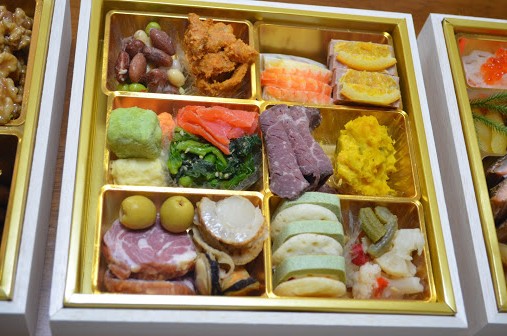
On New Year’s Day, we will eat special traditional food called o-sechi. This was delivered to our house today in the form of a stack of 3 boxes tied up in a cloth. It has to be kept frozen until New Year’s Eve, and we couldn’t fit it into our tiny freezer, so we brought it over to Yuko’s dad’s place to store it in his freezer.
It’s traditional to clean the house thoroughly from top to bottom, and to have everything looking nice in preparation for the new year. So we spent much of today scrubbing the cooker and the bathroom. It’s a good motivation to do a proper cleaning, even if it is only once a year!
A lot of shops are closed around New Year, so the days before can be a bit hectic as people try to get all their grocery shopping done. We headed out early to a nearby supermarket (Sun Plaza in Mikunigaoka) and I took the opportunity to take some photos.
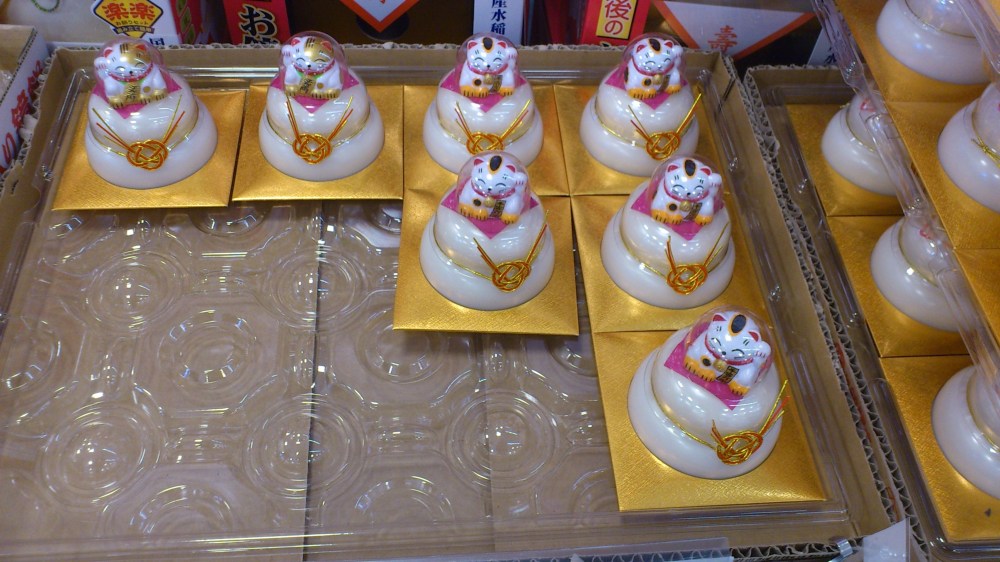
Here is a display of kagami mochi in all different shapes and sizes:

The original concept of kagami mochi (literally, “mirror mochi”) is two sticky rice balls (mochi) on top of one another, with a decoration on top (for example, a small citrus fruit called daidai). However I am not clear on exactly what is on sale here in its modern incarnation. Judging by the illustration on the side of the box, it may be a container (edible?) with lots of mochi inside.

We bought a small one with a maneki-neko (beckoning cat) on top. Oddly, not all the manekineko are identical; some are left-handed.
Here are wreaths that you are supposed to drape on top of your kagami-mochi.

I mentioned before that Japan has a bewildering array of types of citrus fruit. These ones are dekopon, from Kyushu. As Wikipedia explains, they are a cross between a kiyomi and a ponkan. They are also expensive.

The inscription on the box says:
“The flesh is soft and is juicy. It smells, and it is rich and very sweet. The sun in Saga was bathed in enough, set up, and it grew up”.

These are dried persimmon (a delicious treat which we tried on our recent trip to Gifu):

Here are dried persimmon on a stick (kushi kaki) from Wakayama. The kanji character 串 kushi means “food on a skewer” and is one of my favourite characters because it looks so like what it means. Each stick costs 498 yen.

These beautifully-presented “excellent musk melons” come from Kagoshima and cost 1580 yen each.

Sun Plaza had a display of foreign sweets, including Cadbury’s chocolates, TimTams (for homesick Australians), Haribo, Walkers shortbread, and so on. I wondered whether there was a market for such items, as I can’t imagine they get many foreign shoppers.

Buy a case of beer and get a free house-cleaning item for your New Year clean-up. The picture on the yellow box shows the 7 lucky gods in a boat.

One of the 7 lucky gods is Ebisu, and he is also a brand of beer. I bought a six-pack which came in a free Yebisu cooler bag, featuring a picture of the god holding a fish.

The brand name uses the archaic spelling “Yebisu”. Modern Japanese does not have a “Ye” sound; the Japanese word for yen is en. If you look at the white label attached to the front of the beer cooler, you can see “Yebisu beer” written in Japanese as ヱビスビール, using an old character ヱ that is no longer used in modern Japanese.
Note on the word of the day:
The Japanese word for “weekend” is 週末 shuumatsu. Similarly, the word 月末 getsumatsu refers to the end of the month, and 年末 nenmatsu to the last days of the year.




 awordfromjapan