ソファ Sofa

So, last time we saw the sofa, it was being lowered out of our window on a rope.

DSCN5107

and driven away in a van, along with 15 boxes containing the rest of our possessions.

DSCN5109

That was almost 3 months ago, and almost 10,000 kilometres away.

Today, at long last, our sofa was delivered to the driveway of our new home in Ireland.

DSC_0041

The journey had taken much longer than we expected.

We received a notice that our goods had been loaded onto MOL Excelsior in Kobe. Nowadays, you can track any vessel in the world through a system called AIS, so I excitedly logged on to marinetraffic.com to follow the path of our personal effects as they made their way from Japan to Ireland. But during the next few weeks I became confused as I watched the ship shuttling back and forth between ports in East Asia. Why is it going back to Japan with all our stuff? That’s the wrong way! When is it coming to Ireland?

Unbeknownst to us, our boxes had been unloaded in Singapore, and on 2nd June they were loaded onto MSC Irene, which delivered them to Dublin on 28th June, having successfully eluded the pirates of the Straits of Malacca and the Horn of Africa.

It took a further 12 days for our personal effects to clear customs, in what must have been an impressively thorough scrutiny of a pile of used clothes and kitchenware. Part of the reason for the delay was a bottle of wine and a couple of half-empty bottles of spirits. They were in our kitchen when we were leaving, and we put them in the boxes to bring home. Had we known they would cause a problem we would have just dumped them.

I was very impressed with the bespoke cardboard container that WorldTrans had manufactured for the sofa. A lot of time and care, not to mention ingenuity, had gone into crafting it, cutting each piece of cardboard to shape.

DSC_0043

To be honest, I hadn’t really thought that the sofa would survive the journey intact. It’s a white leather sofa, and I expected that at the very least it would be badly scuffed, if not completely ruined. So I was pleasantly surprised to find it swaddled in masses of bubble-wrap and safe inside its protective cardboard cocoon.

DSC_0044

Our rental house came furnished, and it will be a bit cluttered when we add our own sofa. Especially now that the house is full of boxes waiting to be unpacked.

So for tonight, I’ve left it outside. We’re having a spell of warm, dry weather in Ireland right now, and there is something appealingly decadent about having comfy indoor furniture outdoors. If the weather remains fine over the weekend, we can sit outside in the sunshine.

We wonder if the dogs remember the sofa from our home in Japan. Perhaps the smells remind them of their life there.

So now only our car remains on the high seas – it is currently aboard the Opaline en route from Rotterdam, and due to arrive in Dublin on Sunday morning. But that is another story.

浜 hama—beach

For our first two weeks back in Ireland, we were living in Sandymount, on the shore of Dublin Bay. At low tide, a vast area of flat sand is exposed, extending far out into the bay. It’s a great place for the dogs to run around. This is the beach where Stephen Dedalus “walked into eternity”, and it often looks as if it is possible to do just that. I became curious to know just how far from the shore you really can walk, when the tide is at its lowest. One Sunday morning I got up at 6 a.m. and set off with the dogs to find out.

DSCN5117

Such an adventure is not without its perils, as this sign reminds us:

DSCN5139

This warning is no joke, and I didn’t take it lightly. I am no stranger to the risks of incoming tide, having got into serious trouble in the past and been lucky to survive. On this occasion I made sure that when the tide turned, we would be on our way back, even if we had not reached the edge of the sand.

The greatest tidal range (lowest and highest tides) occur in March/April and September/October, around the time of the full and new moon (actually there is a lag of a day or two). In March 2011, there was a spectacularly low tide, about 4 cm over datum, and my dad and I took the opportunity to explore the sea bed at Shankill beach, where we hoped to find the remnants of a drowned mediaeval village.

On this Sunday in May, the tidal range was not so great, the low being around 70 cm OD, so it was not a day for setting records. Nonetheless, the sea had retreated very far, almost out of sight. The two ships visible on the horizon look odd, almost as if they are sailing across the sand.

DSCN5116

One thing I learned in recent weeks is that the sand is not at its driest at the time when the tide is lowest. The recently exposed sand flats hold a lot of standing water in ripples and pools, and it drains off into channels which resemble streams or rivers crossing the beach. The largest of the channels is called “Cockle Lake” on the charts, or as Joyce would have it “Cock Lake”. The sand continues to dry out for several more hours until eventually inundated by the returning tide.DSCN5118

So, while it is necessary to choose the time of low tide to establish a distance record, this is not the most pleasant time to walk on the beach. Humans and dogs are liable to get their feet wet.DSCN5120

Between the channels there are larger areas of relatively dry sand. It is here that one is liable to get stranded by the incoming tide. Even at its fastest (about 3 hours after low tide) the average speed over ground probably doesn’t exceed 1 km/h, so it will not outpace you. But it will outflank you. The incoming tide backfills the channels and divides the strand into temporary “islands”, so that you can be standing on a dry (but shrinking) sandbank and be surrounded by deep water. This happened to a family some years ago, and by the time they were rescued by the lifeboat, the father and mother were chest-deep in cold water and holding their young children. Thankfully nobody was harmed, although it must have been a very frightening situation.

In this photo we are looking back at Strand Road in Sandymount from a distance of around 500 metres from shore.

DSCN5119

This next photo is taken at a distance of 1 km from shore. The UCD water tower and the RTE TV mast are visible near the right of the picture. The Aviva stadium is also visible but may be hard to make out.

DSCN5131

Looking north from the same point, we are parallel with Poolbeg power station and the Shelly Banks. The little muddy spirals on the beach are the casts of lugworms, often dug up by fishermen and used as bait.

DSCN5128

In the end, we reached a point about 1.4 km from the shore before turning around and heading for dry land. Had I been more reckless, we could certainly have gone much further; as you can see in the photo below, the edge of the sand still seems very distant.

DSCN5125

But time and tide were against us, and I was taking no chances. Here is an image of our track on Google Earth:

Sandymount track

On our way back to shore, we came across these seaweed-covered rocks; a rare splash of colour in a world of greys and browns. Strange to think that 6 hours later, they would be under 5 metres of water.

DSCN5133

We also found this mysterious rope. Each end disappeared into the sand and was firmly stuck.

DSCN5135

太閤道 taikou dou—the regent’s way

Yesterday Yuko was visiting friends near Tokyo, and I took the dogs for a 15 km walk in the hills in northern Osaka.

DSCN5034

The trail is 太閤道 taikou dou—the Regent’s way, called after Toyotomi Hideyoshi, the 16th-century Imperial Regent, who apparently crossed this mountain after the Battle of Yamazaki. The trail isn’t very demanding, though it is reasonably steep in places (and if you venture off the trail, the terrain can be very steep indeed). The summit of the trail is around 315 metres, and the two ends are around 55 metres elevation, so if you do what we did and walk it both ways, the total ascent is around 1000 metres.

DSCN5035

Although it was a sunny and warm Saturday afternoon, there was almost nobody else around, so the dogs were able to enjoy running freely off the lead.

DSCN5038

At a couple of places, the forest cover opens out to give a view over the Yodogawa River and Osaka’s northern suburbs.

DSCN5036

For the first half-hour or so, the feeling of peace and serenity was spoiled by the sounds of election campaigning echoing up from the town below (Shimamoto). Japan really is a very noisy country, with vehicles driving around with megaphones blaring competing political messages at unbelievable volume, people shouting outside every store, a non-stop bombardment of recorded warning messages and commercial messages in the street, in the shops, on the trains and in every public space. But as we walked further into the woods, we were able to escape the noise and enjoy a sense of calm and isolation.

Deep in the woods is the ruin of a temple called 金龍寺 konryuuji (Temple of the Golden Dragon). The temple stood for 12 centuries until in 1983 it was burned to the ground by a camper’s fire that was not fully extinguished. It has not been rebuilt.

DSCN5040

At the site of the temple’s main buildings, I met the Golden Dragon’s smaller cousin, a シマヘビ shimahebi, about 5 feet long. He watched us very intently.

DSCN5042

Near the temple buildings was a clearing planted with Japanese irises (hanashoubu).

DSCN5044 DSCN5046

This water feature and island can also be found in the grounds of the former temple.

DSCN5047

This signpost in the clearing points the way back to 若山神社 Wakayama Jinja, the shrine at the east end of the trail. The leaves of the maple trees are newly opened.

DSCN5048

This pine tree has lots of shiny “chestnuts” growing on its bark. In Japanese, it’s called ヒトクチタケ hitokuchitake (literally: human mouth mushroom).

DSCN5049

Magnolia trees add extra variety of colour to the forest canopy in spring.

DSCN5050

Note on the word of the day:

Toyotomi Hideyoshi is known by the title of 太閤 taikou—retired regent.

There are numerous words in Japanese with the pronunciation “taikou“. For example:

  • 大綱 taikou—a large rope;
  • 対抗 taikou—opposition;
  • 大公 taikou—an archduke;
  • 対向 taikou—the opposite direction;
  • 退校 taikou—expulsion from school;
  • 体腔 taikou—body cavity

and many others.

This tendency to homonymy is especially prevalent among compound words of Chinese origin. The Chinese pronunciation of a character is drawn from a very limited pool of available syllables, so there are dozens of characters with the pronunciation sen, dozens pronounced yuu, and so on. Both 買 buy and 売 sell, although they have opposite meanings, share the same “Chinese” (Sino-Japanese) pronunciation: bai.

This means that any single character, spoken out of context, is effectively meaningless, and even when 2 characters are combined to form a word, it can still be ambiguous.

For example: 漁師 ryoushi is a fisherman, whereas 猟師 ryoushi is a huntsman. The two words are pronounced identically, and it may be impossible to tell, even in context, which is meant. (There are many other words with the same pronunciation.)

Another example: on the Japanese computer keyboard, there are two special keys called 前候補 zenkouho—previous candidate; and 全候補 zenkouho—all candidates.

These words can not be distinguished in the spoken language, but the meaning is completely clear when they are written in kanji.

This is a key argument against the abolition of the Japanese writing system.

(The standard counter-argument goes like this:

Clearly Japanese can be understood when spoken. So if you have a system that adequately represents the sounds of the spoken language, why would not that also be comprehensible? Furthermore, the Koreans have successfully changed over from kanji to a phonetic system.)

公園 kouen—park

There is a huge park at the end of our street.

DSC_0122

The name of the park is Ooizumi Ryokuchi, and it’s about 1.3 kilometres long in a north-south direction, and around 800 metres wide. Within its boundaries, it offers an amazing variety of different kinds of environment and amenities: woods, lakes, small hills, gardens and facilities for various kinds of sports.

The yellow sign is in the characteristic shape of a gingko leaf. Gingko is a very familiar tree in Osaka. The main road alongside the park is lined with them, as is Midousuji Avenue in front of my office building.

First thing every morning, since we arrived in Japan last March, I go for a walk with the dogs in the park. Very often we go there in the evening too. In this way, I’ve got to know Japanese nature in its various moods, and experienced a full cycle of seasonal changes.

DSC_0125

DSC_0123

Yesterday evening we were out for our evening walk and it occurred to me; the one place I had visited more than anywhere else, that I had got to know and love, had not yet featured in a blog post.

So I decided to go out this morning and take some photos. Fortunately, the day was hot and sunny.

DSC_0121

This is the main park building. It includes a covered platform built out into the lake.

DSC_0115

In front of the park building, stretching out along the main north-south axis of the park, is an area of formal lawns and flower-beds.

DSC_0113

DSC_0112

Nearby is a “sensory garden”:

DSC_0109

DSC_0103

One aspect that I like a lot: as well as the paved roadways, there is a separate network of paths called 樹のみち ki no michi—tree roads, which also link up all the different parts of the park, but allow you to experience it in a completely different way.

DSC_0099

Thanks to the policy of hanging signs on the trees, indicating the type of tree, I have been able to learn a lot about Japanese trees. This one, for example, is a kind of evergreen oak tree called arakashi (Quercus glauca).

DSC_0128

Here are pine trees and camellias in bloom.

DSC_0127

This sign shows the way to the “King Tree”.

DSC_0086

And here’s the king tree – a largish camphor tree right at the edge of the park. Compared to the 500-year-old camphor trees in our local shrine, it’s not particularly big. But in a park of relatively young trees, it is the king

DSC_0088

At this time of year, the plum trees are in full bloom.

DSC_0097

DSC_0118

DSC_0117

DSC_0126

DSC_0124

There are many cats living in the park. They are generally well-fed; some people come along at night and feed the cats, although you are not supposed to.

This sign asks people not to abandon cats or dogs in the park.

DSC_0080

While this sign warns that abusing animals is a crime.

DSC_0129

The rule is that dogs must be kept on a lead in the park. However, there is a newly-developed area of the park (we call it the “future park”) where hardly anyone ever goes except us. When there is nobody else around, I let the dogs off for a run. Here, Shiro has crossed the fence and is exploring the real “future” park; an area that has been acquired but not yet developed as parkland.

DSC_0083

This is the sakura no hiroba—cherry field. In a few weeks, this will be crowded with people enjoying o-hanami. But for now, a few people are taking advantage of the warm March sunshine to enjoy a picnic lunch.

DSC_0078

And this is hitsuji no hiroba—the sheep field. In a place where sheep are a less familiar sight than in Ireland, the park has three young rams on display.

DSC_0120

And another reminder that we have been here for almost a year: the park’s plant market will start on 17th March.

DSC_0074

Like most of the people we see working in the park, this worker wears a “Silver Sakai” sweater. He is one of an army of “silver” workers, past retirement age, who keep everything clean, meticulously maintained and in perfect condition.

Note on the word of the day:

公園 kouen, a park, is written as 公 public and 園 a garden.

大泉 oo-izumi literally means “great spring”. In fact, however, 和泉 Izumi is a historical name for this area (now the southern part of Osaka prefecture, the portion that lies to the south of the Yamato River). So the name of the park recalls the old name of the province. 和泉 has an unusual reading, because the second character 泉 is pronounced izumi while the first character 和 meaning “peace” is not pronounced at all. Such unusual readings/pronunciations are very common in this part of Osaka.

扇風機 senpuuki—fan

The weather has been fairly chilly recently, but today was amazingly warm for early February. Here in Osaka, the temperature reached 18 degrees, and according to the radio it was almost 20 degrees in Kyoto. We took advantage of the unseasonal weather to pack a picnic and head out for a walk in Tsurumi-Ryokuchi park.

We had set the car navigation to avoid motorways (tolls are pretty expensive) but in hindsight this was a bit of a mistake. I underestimated the distance to Tsurumi-Ryokuchi, and driving in the suburbs is painfully slow, requiring a lot of patience. In the end it took over an hour to get there. I had also overestimated the toll; I thought there was a flat 900 yen fee but in fact it would have been 400.

It made a nice change not to have to wear a coat, scarf or hat. After arriving and parking the car, my first stop before entering the park was to find and log a geocache.

DSC_0942

Inside the park, the area around the windmill which will, later in the year, be a vast field of tulips, was just grass.

DSC_0956

As soon as we came to a small river, Shiro decided to jump in for a swim to cool off, even though he was still on the lead.

DSC_0970

We paid a quick visit to the Irish pavilion,

DSC_0971

and then went into the South Korean pavilion for the first time. That’s Miffy looking at the camera.

DSC_0981

After leaving the park, there was one more thing I wanted to see in the neighbourhood. Apparently, the electric fan was invented in Osaka 100 years ago, in 1913, by a company called Kawakita Denki Kigyosha (KDK). This company became part of the Panasonic Group in 1956.

The factory is long-gone, but this piece of history is marked by a plaque on the wall of the park where the factory once stood. The picture is the “Typhoon”, the first mass-produced electric fan. The text says:

“扇風機発祥の地” senpuuki hassho no chi—The birthplace of the electric fan.

DSCN4817

Note on the word of the day:

扇風機 senpuuki is the Japanese word for an electric fan. It’s written with three characters: 扇 sen is a fan; 風 fuu is the wind; 機 ki is a machine (as for example 飛行機 hikouki, an aeroplane, or 洗濯機 sentakki, a washing machine).

The first model was called “Typhoon”. I always assumed this word was borrowed into English from Japanese 台風 taifuu. But according to Wikipedia the story of this word is much more complex and uncertain, and the article even suggests the word may have been “reimported” into Japanese from English.

カワセミ kawasemi—kingfisher

Yuko spotted a kingfisher yesterday.

DSC_0747

It was a flash of blue that caught her eye as the little bird skimmed low over the water, its wings glinting with a metallic sheen in the winter sunlight. Unfortunately she didn’t manage to catch it in flight.

We were out for a Saturday afternoon walk that brought us around 3 km north from our house to near the Yamato river, and the southern border of Osaka city. Most of this walk was along narrow residential streets in the Amami district of Matsubara city.

Crossing the Nishiyoke River we discovered a park adjoining the municipal water-treatment plant. When the plant was constructed, some land at the margins was set aside as an amenity. It’s called the 今池水みらいセンター ”Imaike Water Future Centre”.

DSC_0742

Unpromising as it sounds, the little stream that wends its way through the park is treated outflow from the plant. But the presence of something as beautiful as the kingfisher shows that it has become a valuable habitat for wildlife.

There was also an egret fishing in the stream. Check out the bright yellow feet.

DSC_0749

Uncomfortable with our attentions, the egret took off and flew away downstream.

DSC_0732

The roof of the water treatment plant is open to the public. There is a rooftop park up there, and probably great views over the Yamato River to the Osaka skyline. But there was a “no dogs” sign at the entrance, so we couldn’t go there this time.

Yuko captured a “family portrait” using the mirror at the back of the lift.

DSC_0755

One thing that surprised me about Japan – when I arrived here last March, all the grass was brown. There was no green grass. Then in summer, with the onset of the rainy season, all the grassy areas turned to a lush and verdant green. Now, as you can see in the photos, it’s all brown again after the winter. This is a little hard to get used to, because in Ireland the grass stays green all year round.

DSC_0738

Note on the word of the day:

カワセミ kawasemi means kingfisher. As I wrote in an earlier post, セミ semi means cicada, the insect whose sound fills the hot summer days in Japan (just as the frogs fill the nights with their call). 川 kawa is the Japanese word for river. So the Japanese name for the kingfisher means “river cicada”.

雪 yuki—snow

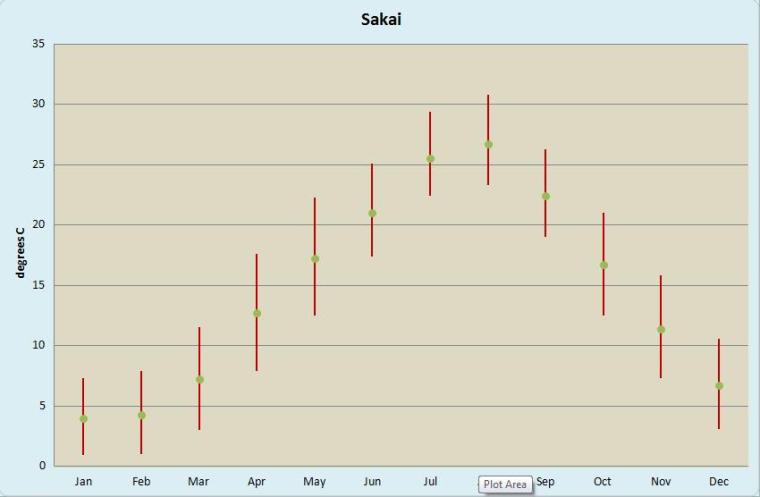
It doesn’t often snow here in Sakai city. In the hills, yes, but not down here at sea-level where we live. Even in winter, the temperature normally remains above freezing.

Sakai weather

But in other parts of Japan, it snows a lot. Nagano hosted the Winter Olympics in 1998, and Sapporo gets over 6 metres of snow a year, making it a contender for the title of “snowiest city in the world”. They even have an annual Snow Festival.

Today we drove to Nagoya, and back. Nagoya is on the Pacific coast, so like Sakai, it doesn’t get much snow. But to get there (to get almost anywhere else, really, from here) you drive across the hilly inland parts where the snow makes for picturesque winter scenery (but probably isn’t so much fun if you actually live there).

route to Nagoya

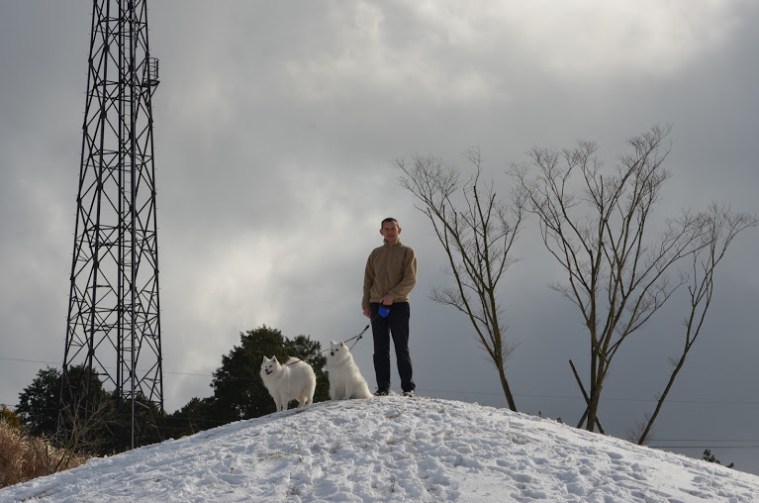
We stopped to let the dogs play in the snow. Shiro especially loves snow, and his first reaction is always to bury his face in it.

DSC_2605

These photos were taken, not in some wild hillside, but in the grounds of Tsuchiyama Parking Area. A motorway service station, in other words. But, thanks to the transformative power of snow, there was plenty of fun to be had, and children were making the most of it, enjoying the break from the long drive.

DSC_2611

There was even a mini-mountain to conquer.

DSC_2617

And to run down again.

DSC_2624

カモシカ kamoshika—serow

Gifu is a remote and mountainous area in the middle of Japan. We went there for the long weekend to see the beautiful colours of the autumn leaves.

DSCN4683


On the Saturday morning we were walking on a hill called Shiroyama (castle hill).

DSC_1817

It’s called Castle Hill because there used to be a castle on the top. Now there’s just a flat clearing and a stone marker where the castle used to be. The marker says 本丸 honmaru, meaning the main hall.

DSCN4676

On the way down the hill, we spotted this animal. It’s a serow.

DSC_1818


He was not very bothered by our presence, and tolerated my coming closer to get a better picture:

DSC_1822

Eventually, he thought I was a little too close for comfort, and clambered to his feet. I backed off and gave him some space.

DSC_1832

What’s a serow? Well, in Japanese it’s called a カモシカ kamoshika. Serow have an unusual ability. They can make vinegar with their faces. They have an extra set of nostrils below their eyes, from which they secrete vinegar.

Note on the word of the day:

The Japanese word for deer is シカ shika. In English we use the name “sika deer” to refer to the type of deer that is native to Japan, and now lives wild in Ireland and other countries, having been introduced from Japan. Since “sika” just means “deer”, a sika deer is a “deer deer”. The serow is called kamoshika, which looks like it means “duck deer”.

Strictly speaking, a serow isn’t a type of deer, but a type of “goat antelope”.

花 hana—flower

There was a big flower Expo in Osaka in 1990. The site of the Expo is now a beautiful park, which I wrote about in an earlier post.

In the park you can see the pavilions that were created by different countries for the expo. For example, this one from Korea.

It’s fascinating to tour this collection of architectural and landscaping features from all over the world, and to see how each country chose to represent itself. For example, Canada created this mini-Niagara:

Somehow on my last visit, I had been unable to find Ireland’s pavilion, and I was determined to track it down today, curious to see what Ireland had chosen to do with its little patch of Japan. Well, we found it, and I was not disappointed!

In the Ireland pavilion was a miniature version of Newgrange.

Noticing the gap over the lintel, we wondered if it “works” (i.e. is it aligned with the winter solstice sunrise, so that the first rays of sun illuminate the passage?) Reading the plaque, it seems the answer is “yes”!

At 8:58 a.m. on the morning of the solstice, the sun shines in 19 metres along the passage. I think we should try to go there on that date and experience it for ourselves!

In addition to the model of Newgrange, they had built a beehive hut, of the kind that hermit monks used to live in, and a central water feature with stepping stones, intended to evoke the story of the Children of Lir. Dry-stone walls were used for the boundary.

Of course, the various countries’ pavilions have stood for 22 years and will gradually deteriorate over time. In the case of the Irish pavilion, the stone structures have weathered well.

At this time of year, the park features a display of cosmos flowers.

In Spring, this little hill is planted with tulips, and the effect is topped off by a full-size Dutch-style windmill.


Tsurumi Park is a very popular place for photo-shoots. As you walk around, you see lots of people dressed up like manga characters, accompanied by a serious looking photographer, on their way to the photo-shoot location.

On our way to see the cosmos, we met a man cycling with a parakeet. The parakeet sat contentedly on Yuko’s shoulder while we chatted.

At one point, the bird started nibbling on her earring, but she was able to distract it with some sunflower seeds. Apparently the parakeet is over 20 years old. By the way, this Orla Kiely top is now available in Japan.

There was also a “kids’ festival” with children playing drums. They had a pretty good rhythm going, for such young kids.

Today, we saw the first sign of autumn colours. This maple is just starting to turn from green to red.

In the next couple of weeks, we will be able to experience the full glory of the Japanese 紅葉 kouyou—autumn leaves.

Over to the west of the park, we spotted a temple with this fabulous pagoda.

Note on the word of the day:

The character 花 hana meaning “flower” is also found in the word 花火 hanabi—fireworks (literally “flower fire”).

花 is a good example of how Japanese characters typically encode both sound and meaning. The top part艹 (it’s called the “grass crown”) tells you that it’s a kind of plant or herb, and is also seen in 茶 cha—tea and 草 kusa—grass, among many others. The bottom part is 化 which has the Chinese reading ka. So the character represents a plant with the Chinese reading ka, namely a “flower”.