Hirano is a part of Osaka city that probably doesn’t get a lot of tourists. And that probably should. Modern development has largely passed it by, so it retains a lot of traditional character and has an unbelievable number of interesting shrines and temples in a small area.
This is Kumata Jinja, a shrine that (so we were told) has the oldest wooden shrine building in Japan.

Hirano isn’t far from where we live, so it was a good choice for a walk on a sunny winter afternoon.
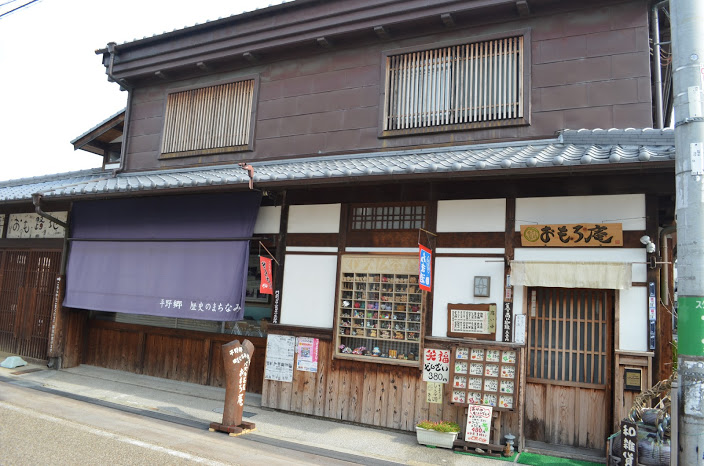
We visited this traditional sweet shop.


The sweets in the window display are manjuu, very sweet confections in the form of fruits, animals, etc. Their specialty is manjuu in the form of a turtle.
(Some of these photos, including the two above, were taken on a previous visit in October).
This time I bought one in the form of a white rabbit, and one that looked like a turtle. Only after I had bought them did Yuko point out that I could re-enact the tale of the hare and the tortoise.

Lots of the shops in the narrow streets of Hirano have windows with little displays of historical artefacts.

The object on the bottom left of the window is the predecessor of the modern electric rice-cooker: 竈 kamado (traditional earthenware oven) and 羽釜 hagama (metal pot for cooking rice). One of my employer’s first products, 100 years ago, was a gas-fired kamado, a labour-saving improvement on the original solid-fuel type. Even today, the company designs modern kamado and hagama for supply to certain restaurant kitchens.
The window of this café has a display of old-fashioned toys.
We discovered from one display that the traditional streetscapes of this part of town are not entirely original—it’s partly the result of a restoration effort that, for example, replaced metal roller-shutters with wooden sliding shutters.
This early 20th-century western-style building was once a newsagent, and bears the logo of Asahi Shimbun newspaper. Now the building faces into a covered shopping street.

Most memorable was our visit to Senkouji Temple, which contains the “door to hell”. At the entrance, we were welcomed by this sign:

This scary (and hairy) 3-eyed character says “if you tell a lie, I will pluck out your tongue”. As you can see from the picture, this is not an idle threat; he is carrying a large pair of pincers in which is gripped the tongue of some unfortunate (but mendacious) wretch. The words for “door of hell” are wreathed in flames.
In the courtyard, there is an electronic questionnaire, that purports to assess your likelihood of ending up in hell. (If you answer truthfully, that is. If you don’t answer truthfully, presumably a three-eyed demon will be along shortly with his pincers to pluck out your tongue.)

The questions relate to whether you are considerate or selfish, gluttonous or frugal, patient or short-tempered. I scored in the “4 to 7” (green) range, which is the 2nd-most likely to go to heaven. Which is nice to know.
Thus reassured, I ventured into the door of hell.

This was a little unnerving, as I found myself face-to-face with Enma-Daiou, the lord of hell himself.

Below the statue was a gong. In some trepidation, I picked up the stick and struck the gong. This caused a monitor screen to flicker into life, and a booming voice to start telling me about the horrors of hell. For once I was glad of my limited ability to understand Japanese.
On the screen, there was a “hell-movie” consisting of strange impressionistic images representing human souls in torment, accompanied by sounds of wailing.
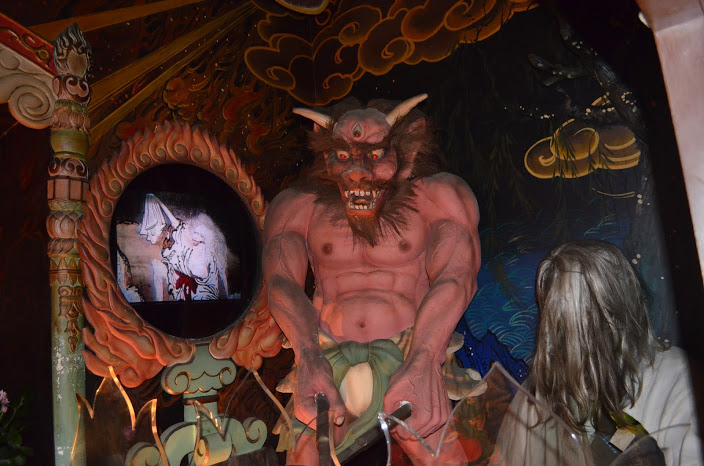
On my right, we see the hairy 3-eyed demon guy again, wielding a pincers that seems way too large for the task of amputating a tongue, and even more scary, a woman with (thankfully) hair hanging down over her horrible face. This is Datsue-ba. After you die, she takes off your clothes and weighs them. If you are wearing no clothes, she strips off your skin and weighs that instead. For good measure, she also breaks your fingers and ties your head to your feet. (Thanks Wikipedia for those nightmares!).
I didn’t wait for the booming voice and the screen images to finish. After a couple of minutes I had had enough of hell and went back out into the sunshine. There I found a rock with a hole in it. Supposedly, if you put your head in the hole you hear the pot of hell (what’s the pot of hell?)

I tried it, but I didn’t really hear anything.
Leaving all such hellish thoughts behind, we resumed our pleasant walk around Hirano.

Note on the word of the day:
So, what’s all this about hell? Demons, eternal torment, isn’t that more associated with the Christian tradition? Isn’t Buddhism supposed to be all peaceful and meditation and Nirvana and stuff?
All I can say is, religion in Japan is very complicated. Religious belief and practice seems to draw on many traditions and weave them together into a fascinating tapestry, the boundaries between Shinto and various strands of Japanese Buddhism especially hard to discern. There are also many points of seeming convergence with western religious traditions. As an outsider, I have no hope of trying to understand it, only to observe.
In this case, the traditions seem to have originated from Hinduism. Enma, the lord of hell, was the Indian god Yama.
地獄 jigoku literally means “ground prison”, conveying the idea of being imprisoned underground.














 awordfromjapan
